Friday, December 30, 2011

Ishinomaki Case Study: Recovery of Maruka Pro Fish Shop

Maruka Pro shop in November 2011

Although this article is a little different than what we usually post on FVJ, I thought it might be interesting to look at the current state of businesses around Tohoku, and discuss the steps they are taking in order to re-open.  

In the case of the downtown of Ishinomaki, the first business to recovery quickly with a unique plan that I had come across was that of the Maruka Pro Fish Shop. 
Fig 1: Maruka Pro Shop shown during the initial post-tsunami clean-up.

There may have been a time when recovery from a disaster for small businesses just involved getting the mess cleaned out, the damage repaired, new product ordered in, and hanging a "business as usual" sign on the door. However, this is no longer the case. Even for small businesses, the business model today is complex and being able to continue following an interruption of any kind relies on a wide understanding of all the influences that could affect it as well as having carefully prepared plans to get those influences back together following the disruption.


Not only do small and medium-sized businesses need to struggle and work hard and fast to survive commercially, when battling against big-box stores and internet-shopping. While potentially being exposed to incidents that are outside their control, small businesses in most industries also need to operate within tight-industry regulation, and to stay on top of their own business processes, personnel and procedures.


"80 percent of businesses without a well 
structured recovery plan are forced to shut down 
within 12 months of a flood or fire."
(Source: London Chamber of Commerce and Industry, 2003)

Sadly, as many as 80% of businesses hit by fire, storm damage, tsunami, or earthquake go out of business within a year because they have not planned effectively for recovery. The downtown Ishinomaki case makes this especially clear. Nine months following the disaster, many of the businesses in the downtown core, and the majority of businesses in the Watanoha district have failed to come back online. 


 May 25th Reopening poster for Maruka 


Estimates of the direct material damage of the tsunami are said to exceed ¥25 trillion ($300 billion), but insurance and government coverage will only be able to cover a fraction of those losses. Although there's not much that can be done in the cases where an entire business' physical location, and many of the management and staff members were lost, there are several other cases where the lack of a business continuity plan to resume business elsewhere, also contributed to the post-disaster closure of the business. The case of the Maruka Pro Shop in Ishinomaki is a strong case for following the Best Practices scenario for post-disaster Business Continuity Practices.


Business continuity planning is not only necessary to protect an organization against extreme disasters such as the big-three cases that affected the East Coast of Japan, it's also important to take into account the importance of preparing for electrical problems, IT failures, theft, damage, or irregular and unseasonal local conditions. What should a business do in the case that their best people suddenly resign? Or if one of their key suppliers goes under? Or a new competitor opens up nearby?  Creating contingency plans for all of these cases, on top of larger disasters, and understanding the impact on day-to-day business planning,  is essential for maintain both day-to-day business, and preparing for long-term profitability.


Despite being completely gutted by the tsunami, losing long-term access to the local fishing pier due to infrastructure damage, losing ice suppliers, and losing many of its customers in the local region, the Pro Shop Maruka managed to reopen its doors on May 25th (only 64 days after the tsunami) in the hard-hit coastal district of Ishinomaki, thanks to effective business continuity practices.
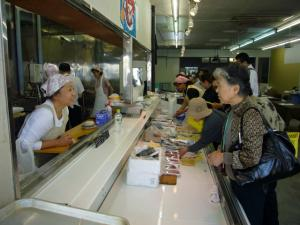
Pictures of the re-opening day of Maruka Pro Shop on May 25th.


The Maruka Pro Shop is managed by a Mr. Masahiko Sasaki and his wife, Mrs. Kazuko Sakaki. Mr. Sasaki has come to be known as the "Walking Fish Dictionary" thanks to his expansive knowledge of different types of fish, their habitat, uncountable ways of preparing and cooking fish, as well as knowing much about the deep link between the sea and Japanese folklore. He can always be seen first thing in the morning at the local sea ports, haggling and bidding for the biggest and heartiest fish to be caught.


Mrs. Kazuko Sasaki comes from a long lineage of fishermen. She is the eldest daughter of the president of "Miyamoto Fisheries" which has been operating since well before the Meiji Era. It was her idea to refocus Masahiko's business on the professional sector, to become a provider of top quality and bulk fish products for small and medium sized businesses across Miyagi.


The Sasaki's had lived through smaller disasters before. They were familiar with how a tsunami could affect local businesses and the fishery sector, by experiencing the tsunami generated by the Great Chile quake of 1970.  They knew that fishing supplies would be momentarily disrupted, and expected there to be damage to their main shop.


They studied the breakdown of their business, and worked hard in developing business continuity planning processes and practices that would ensure that, whatever the disaster, the day to day activities of their shop would be able to get back up and running quickly. This included clear processes for their employees so that there is no doubt what action to take, whatever the circumstances. In the case of potential tsunami, the shop workers were well trained in escape routes to nearby hills. The Sasaki's emphasized that personal safely was the first priority, and told their staff to drop what they were doing, and to run to the hills.  


Since Pro Shop Maruka is a middleman, acquiring fish directly from the ports, and selling it to smaller and mid-size businesses, rather than walk-in customers, they were very dramatically hit by the tsunami. Since most businesses in the downtown district had their first floors devastated, and partial flooding of the second floors, many businesses ended up going out of business completely. Since insurance companies refused to cover coastal businesses with tsunami or flooding insurance, and government compensation would only be enough to cover personal living expenses, most businesses without and effective business continuity plan have been unable to cope post-tsunami.

Employing teams of local volunteers, coordinated through local Volunteer Centers, and by visiting the temporary offices of Peace Boat and other local post-disaster NPOs, the Sasaki's were able to get their shop cleaned out, remove the tsunami sludge, and remove any rotting insulation within the first couple weeks following the disaster.


Once their store-front was moderately recovered by early April, they followed up with a plan to offer the front part of their shop to their pre-disaster customers. Since the majority of coastal businesses were devastated, this means that many of their own customers had also lost their shop fronts. An important element of disaster planning involves contingency plans for not only the acquisition of materials, and relocation, it also means finding ways to protect or recover your customer base.


In Pro Shop Maruka's case, they extended the offer to four of their local customers, who had lost their own businesses completely. The Takigawa Japanese restaurant, Baorai Sushi, Ishikawa Sukiyaki, and the Loulan Chinese Restaurant. With a date set for a May 25th opening, the Sasaki's invited the four businesses to set up small stalls in the front of the Pro Shop Maruka. They worked with the Ishinomaki 2.0 and IDRAC (Ishinomaki Disaster Recovery Assistance Council) to secure loans for buying new stoves, fridges, and supplies, and used the power of social media and local newspapers and radio broadcasts for promoting their business.


Pro Shop Maruka excelled at putting their Business Continuity Plan into action, and serves as a beacon for other tsunami, and disaster-affected businesses to prepare for worst-case scenarios comprehensively and effectively. 

Wednesday, December 7, 2011

We Will Always Remember You

In October, Kenji Araki, a director from NY came to Tohoku to film a video as part of another project, and joined the It's Not Just Mud crew for a couple days. This video is addressed to international citizens as a thank you message from the people of Tohoku, and really conveys a warm and encouraging message.

To the people of the world: there is a video we would like you to see.
On March 11, 2011, at 2:46pm, the Pacific coast of the Tohoku region of Japan was hit by the most powerful earthquake the country had ever experienced. As the overwhelming scale of the destruction from the quake and resulting tsunami became clear, and the number of lives reported lost continued to climb to reach over 10,000, the people of our country were devastated with grief and a sense of dejection.

It was during this time that you, the people from different countries across the world, called out to us with a message of strength and support: “Ganbare Nihon!”—Be strong Japan! You lifted out spirits and gave us the courage to keep our heads up and move forward.

Nowhere is this feeling of appreciation stronger than it is with the people of Tohoku. Anyone who has spent time helping with the rebuilding efforts knows how strong these people are, and how thankful they are.

This video by Kenji, titled “We Will Always Remember You” begins with a series of video footage showing the terrible disaster the earthquake wrought.It then turns the spotlight to Taylor Anderson (then 24), an American assistant language teacher (ALT) in Ishinomaki City, Miyagi Prefecture—one of the areas hit hardest by the disaster.

Anderson, was teaching at an elementary school when the earthquake hit, stayed with the frightened children until they had all been safely evacuated. However, on the way home, Anderson herself fell victim to the tsunami that came rushing in after.

Anderson’s students appear in the video and speak of their memories of their teacher: “Taylor sensei was really nice. She really cheered us up when the earthquake struck.”

There were many other touching scenes in the pre-production footage that Kenji showed the It's Not Just Mud crew when he stayed with them in October, and it's great to see the wonderful final product. As Jamie of INJM puts it "If you have been to Tohoku post disaster on any kind of relief mission, this video is relevant to you. Feel free to share."

It's only 7 minutes, but definitely worth watching. I'd recommend having a box of tissues handy nonetheless.


Update: Since the video was pulled from YouTube by the Japanese Chamber of Commerce and Industry of New York due to copyright infringement, despite the wish of the director for the video to find as large an audience as possible, we have embedded a version shared on a Japanese video sharing site below. Please check it out. 

 
Here is an earlier video also by Kenji Araki filmed on March 17th, and conveys a message of support and solidarity for Japan. Ice T and Robin Williams also make appearances in the film.

Thursday, December 1, 2011

Please fill in the Survey on tokyo hazard vulnerability and preparation

Relief supplies for Minamisoma - During delivery by Rescue Japan

Please fill in the Survey on tokyo hazard vulnerability and preparation

This survey aims to gather information related to disaster preparedness from residents in Tokyo targeting 4 Wards (Edogawa, Koto, Meguro and Minato)

It focuses on the following hazards Floods, Tropical storms and Typhoons, Water scarcity, Fire, Extreme heat, Extreme cold.

Fill in the form here:
https://docs.google.com/spreadsheet/viewform?formkey=dGVBWVFMNkUxZFdFeVRDdnlRb1VpV3c6MA

Results will be used for a presentation in December and essays to be completed by the New Year. Basic data will be posted in mid December (http://sarajeans-notes.blogspot.com/)


東京の災害に対する脆弱性とその防災意識調査

Please share this link for the J survey on hazard preparedness:
https://docs.google.com/spreadsheet/viewform?formkey=dFdZM29ONllzNVdsLWg5cHNRcU1jR2c6MA

東京の災害に対する脆弱性とその防災意識調査

こ の調査は、国連大学の災害と人道援助のコースの履修生によって行われています。東京都民の災害に対する防災意識についての情報を収集しております。洪水、 熱帯性暴風雨、台風、水不足、火災、猛暑、厳しい寒さといった天候に起因する災害に焦点を絞ってご質問させていただきます。 お近くにお住まいの地域の方々にもこのアンケートに答えてくださるようお誘いいただければ幸いです。東京の住民のウェブサイトにもお載せいたします。

お時間を取らせていただいて恐縮ですが、よろしくお願いいたします。

Saturday, November 5, 2011

It's Not Just Mud

INJM Working on a landslide-relief project in Onagawa town.


This is one of the groups in Tohoku that has played gracious host to Foreign Volunteers Japan members on several visits up to Tohoku so far. The group was originally formed in the famous "Tent City" in Ishinomaki, that ran from mid-March until September 30th, on the grounds of Senshu University in Ishinomaki.

The founder of the group, Jamie El-Banna, is known as the go-to-guy for information regarding local conditions in Ishinomaki. He has worked closely on projects with the British Chamber of Commerce, Ishinomaki 2.0, Samaritan's Purse, and several others. 

Jamie (far right) welcoming a new group of volunteers to INJM HQ.
While working in Osaka, Jamie travelled out to Higashi-Matsushima on a volunteer trip in mid May. Although that was well after the initial rescue phase of the tsunami relief efforts, the level of devastation and unmet needs of the refugees that Jamie encountered, made him realize that there was still tremendous amounts of work that had to be done for the relief efforts. 

After returning to Osaka, he didn't feel right settling back down in the city. There was still so much to be done in the tsunami-affected regions. After a few weeks, he made the dramatic decision to quit his job, sublet his apartment, and moved out to Tent City in Ishinomaki. That was where the core organizational group behind the It's Not Just Mud project was formed.  

Long-term volunteer Manish already muddy by 10:00am.
The name for the project of course, comes from the initial challenge facing anyone getting involved with post-tsunami clean-up and relief work. Not only did the devastating force of the tsunami destroy much of what it came into contact with, it also covered nearly everything else with a thick layer of toxic, bacteria-breeding, noxious and thick mud. 

Much of the clean-up efforts have been focused on removing this mud… but, as Jamie puts it "it’s not just mud. It's about the people who are living through this terrible tragedy, and helping them get back to a normal life." 


Although the early days of the project revolved around clean-up projects coordinated through local volunteer centers, INJM has since expanded their projects. 

As of the end of September, the It's Not Just Mud project has now moved into two neighboring houses in the Watanoha district of Ishinomaki. Impressed by their volunteer activities, the houses were actually offered to the group by refugees who had been able to move to another district of the city.

Half-restored INJM house in late-September
 When the group first moved in, the first floor of both houses were hollowed-out. The walls and floors had been badly damaged, festering sludge under the floors, and rotting insulation in the walls all needed to be extracted, and shattered windows needed to be boarded up. 

Over the last two months, Jamie's group has worked on-top of their other volunteer projects to restore the house to working shape. By the end of September they had floorboards and walls extracted, and removed the tsunami sludge. Soon after that they put up new walls and floorboards (generously provided by Samaritan's Purse), as well as restoring the water and gas. By early October they replaced the electrical sockets, and soon will have a water heater installed. Even without the water heater, Jamie explained that volunteers are able to visit the local temporary hot-springs facilities for a hot bath.  
Knocking down a wall on a recent project.
 
As for the specific projects of INJM, here are their current four main aims:
  1. Encouraging volunteering – They do this by offering assistance in coming in terms of advice and logistical support.
  2. Salvaging homes in the Ishinomaki area – In many cases, only the ground floor of the home was flooded, and in some cases soaked in sea water for up to three days. Months later, the building materials are waterlogged and rotting, and must be removed. This means removing the walls, ceiling, insulation, and flooring, then the 3-5cm layer of mud that is under everything.
    Normally, this kind of work would be undertaken by a professional builder, but because of the enormous number of damaged homes, the waiting list to get a professional builder is extremely long, and the process is costly. They work with experienced volunteers (several of which are trained builders) to perform this manual labor and gut houses, taking them one step closer to being liveable.
    For some families, they have been living on the second floor of their damaged home for months, passing through the rotting and hazardous first floor daily. Making it safe and clean is a significant improvement for these people.
  3. Salvaging homes further afield – INJM work with both local groups in central Ishinomaki and in more remote areas of the region. They have identified the need for this kind of service in towns across the Oshika Peninsula.
  4. Delivering fresh fruit and vegetables to areas that don’t have access to such things. Now that the Winter is coming, INJM has begun focusing on the distribution of Winter coats, kerosene heaters, and running a 'kerosene pickup and delivery service' for residents of refugee shelters and temporary housing units without access to a car.

INJM volunteers helping a local sake-shop owner restore her business. 


A popular aspect of the group, is the members' great sense of humor, and the openness to new volunteers. The INJM page documents various F.U.Es. Those are the "Frequently Used Excuses" that unfortunately have been preventing many potential volunteers from making the short trip to Ishinomaki. Here are the official F.U.E from the INJM webpage: 


F.U.E – Frequently Used Excuses

Below you can find some of the most common reasons people use to not come. They all have a valid basis, but after reading below, I think you’ll find that in actual fact, there’s nothing to worry about!

I’m worried I’ll find something really scary in the rubble!!
 The Self Defense Force has cleared most of the large debris in Ishinomaki. Most of the work we do is clearing mud that is 2-4cm thick from homes and properties. You might find something that is emotionally troubling, for example people’s personal belongings or photographs, but it is unlikely you’ll find something truly troubling with the kind of work we do.

I don’t have any experience!!
 Everyone has to start somewhere! You will always have someone experienced working with you who can answer your questions and tell you what to do and how to do it. It’s not too difficult, and after a day you’ll quickly learn what needs to be done, and will be able to teach new volunteers yourself.

I’m not very strong!!
 You won’t be asked to do anything you can’t do. Some jobs do require strength, but if you aren’t cut out for that, there are plenty of things you can do. Plenty of women and older people work with us!

I don’t have any equipment!!
 All the professional building equipment will be provided. Please look here for what you should bring!

I can’t book a bus, I don’t read Kanji!!
 Contact us with your dates and we can arrange someone to do that for you.

I don’t speak Japanese/English!!
 That’s OK! On the work site we will always make sure you understand what you’re supposed to be doing, and there are plenty of people around who can help out if you don’t understand. 
  

If you would be interested in joining the INJM project, please feel free to contact Jamie directly at: jamie[AT]itsnotjustmud[DOT]com


Http://www.itsnotjustmud.com


Or visit their Facebook fan group to ask for more information: 

Friday, October 7, 2011

 Foreign Volunteers Japan has begun campaigning with Kanto-based International Schools to collect coats for children affected by the disaster in Tohoku, who will soon be facing a harsh Winter. If you work at, or are involved with a school that might be interested in getting involved, please feel free to contact us at foreignvolunteersjapan (at) gmail (dot) com.

The initial campaign will be centered around allowing students to help students, but will soon to expanding to a larger campaign for collecting halogen and kerosene heaters, heat pads, heated blankets, and other Winter essentials, depending on local needs and requests in the Temporary Housing communities across the Tohoku coastal area.

Please stay tuned and further details will be posted as the campaign evolves.

Thank you sincerely for your support!

Monday, October 3, 2011

Foreign Volunteers Japan - Face To Face

Foreign Volunteers Japan - Face To Face

Come and enjoy an evening of fantastic music and guest speakers, whilst raising money for Tohoku. We welcome everyone interested in learning more about volunteerism.  It is also an opportunity for FVJ and other NPO/NGO volunteers to meet face to face beyond the confines of Facebook.

Let's come together and discuss the successes, failures, joys, frustrations and aspirations of all those trying to help the survivors of March 11th.

Admission fee is 2000 yen (includes 1 drink).
Tickets available at the door.

ALL MONEY RAISED BY THE EVENT WILL GO TOWARDS TO PROJECTS IN TOHOKU.

Musicians:
*Zazushii Monkey*
*The Dead Flower Children Unplugged*
*TK*
*Chris Grundy*

Access:
Biervana
Prudential Tower 1F, 2-13-10 Nagatacho,
Chiyoda-ku, Tokyo 〒100-0014

Akasaka Mitsuke Station
Exit 11 (Sanno-shita District Gate) 1 min

Akasaka Station
Exit 1 (5 min)

Nagatacho Station
Exit 8 (2 min)

Tameike-sanno Station
Exit 8 (2 min)
Advanced-Tickets available via Wazoo:

http://www.wazoo.jp/events/open/469

For further enquiries contact foreignvolunteersjapan@gmail.com

Monday, September 26, 2011

Collating listing of NPO/NGOs focused on longterm Tohoku Recovery.

Sarajean Rossitto of JapanVolunteers is currently compiling an updated listing of organizations focused on the longterm relief and recovery of the Tohoku region. 


She is compiling the list on her JapanVolunteers NGO advisory blog, under the heading "Your help needed - Tohoku relief and recovery org listing."I have taken the liberty of reposting the tentative listing here as well. 


If you see any missing links, or any other groups that you feel should be included. Please feel free to comment directly on her blog, or to post your comments here and I will share them with her. 


Please send the names of the organizations in English and Japanese if possible, and include any relevant links to their webpage, or a bio of their activities if available.


The tentative list is as follows:


  • ADRA Japan NPO法人 アドラ・ジャパン(ADRA Japan)
  • http://www.adrajpn.org
  •  
  • NPO Aichi-net 愛知ネット

  • Association for Aid and Relief, Japan難民を助ける会
  • URL: http://www.aarjapan.gr.jp/

  • AMDA - formerly Association of Medical Doctors of Asia
  • 特定非営利活動法人 AMDA (元アジア医師連絡協議会)
  • URL: http://www.amdainternational.com/

  • Care International Japan 公益財団法人 ケア・インターナショナル ジャパン
  • http://www.careintjp.org

  • CRASH volunteers
  •  http://www.crashjapan.com/

  • FOREIGN VOLUNTEERS JAPAN

  • Good Neighbors Japan グッドネーバーズジャパン
  • URL:  http://www.gnjp.org/campaign/emgcy_2011tohoku.html

  • Hope International Development Agency

  • Hope World Wide

  • The Japan Asian Association and Asian Friendship Societyアジア協会アジア友の会
  • http://www.jafs.or.jp

  • Japan EQ Animal Rescue and Support JEARS

  • JEN ジェン
  • URL: http://www.jen-npo.org/

  • MDMJ Medecins du Monde Japan / Doctors of the World
  • 特定非営利活動法人メドゥサン・デュ・モンド ジャポン
  • URL: http://www.mdm.or.jp/

  • MSF Japan: Medecins sans Frontieres / Doctors Without Borders Japan
  • 特定非営利活動法人国境なき医師団日本 
  • URL: http://www.msf.or.jp/

  • Nippon International Cooperation Community Development NICCO 社)日本国際民間協力会 (NICCO)
  • http://www.kyoto-nicco.org/
  • Online donation in Japanese http://kyoto-nicco.org/give/

  • Nippon Volunteer Network Active in Disaster, Inc.
  • (特)日本災害救援ボランティアネットワーク(NVNAD)
    URL
    http://www.nvnad.or.jp/

  • O.G.A. for AID

  • PARCIC

  • Peace Winds Japanピース ウィンズ・ジャパン
  • URL: http://www.peace-winds.org/

  • Peace Boat ピースボート
  • http://www.peaceboat.org/relief

  • Rescue stockyard レスキューストックヤード
  • http://www.rsy-nagoya.com/rsy/

  • Rescue Japan
  • http://www.rescuejapan.asia/

  • Save the Children Japanセーブ・ザ・チルドレン子ども基金
  • URL: http://www.savechildren.or.jp/

  • Shanti Volunteer Association 公益社団法人シャンティ国際ボランティア会
  • http://sva.or.jp/global/

  • Uniken, Japan Universal Design Research Institute:(Japanese only)
  • http://www.npo-uniken.org/shinsai_busshi.html

  • World Vision Japan ワールド・ビジョン・ジャパン
  • http://www.worldvision.jp/

  • NETWORK organizations
  • They have links with information on the hundreds of other groups involved:

  • Japan Civil Net – Network of the groups working on the Japan EQ/tsunami relief efforts
  • http://www.jpn-civil.net/about_us/groups.html

  • Japan NPO Center – a nation wide network of Japan-based local nonprofits and volunteer groups
  • http://www.jnpoc.ne.jp/

  • JANIC –Japan Association of NGOs in International Cooperation – a network of Japanese NGOs that are involved in international development work
  • http://www.janic.org/
  •  
  • Japan Platform – Network of Japanese NGOs engaged in emergency and relief work
  • http://www.japanplatform.org/E/work/index.html